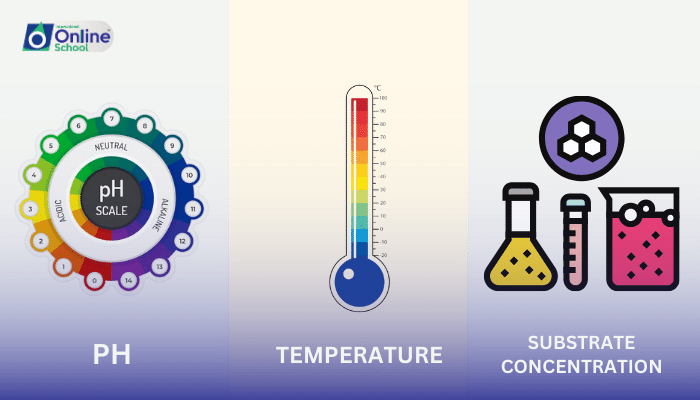
Learning Outcomes in Listing:
i. Understand how pH levels affect enzyme activity.
ii. Recognize the impact of temperature changes on enzymes.
iii. Identify the relationship between substrate concentration and enzyme activity.
Learning Outcomes Described:
Students will gain a comprehensive understanding of the external factors that influence the activity of enzymes. They will learn that enzymes have optimal pH levels and temperatures at which they function most efficiently and that variations in these conditions can enhance or inhibit enzyme activity. Additionally, they will understand how the concentration of substrates can affect the rate at which enzymes catalyze reactions.
Summary of Lesson:
Enzyme activity is not constant but can be affected by several factors. This lesson will discuss three primary factors—pH, temperature, and substrate concentration—that play crucial roles in the functioning of enzymes. Understanding these factors is important for grasping how enzymes operate under different conditions within living organisms.
Content:
i. The Role of pH in Enzyme Activity: Enzymes have an optimal pH range in which they function best. Deviations from this range can lead to a decrease in enzyme activity or denaturation. For example, pepsin works best in the highly acidic environment of the stomach.
ii. Temperature's Influence on Enzymes: Enzymes have an optimal temperature range. Increases in temperature generally enhance enzyme activity to a point, but if the temperature is too high, the enzyme may denature and lose its function. Conversely, lower temperatures can slow down enzyme activity.
iii. Substrate Concentration and Enzyme Function: An increase in substrate concentration typically leads to a corresponding increase in enzyme activity, up to a saturation point. Beyond this point, all enzyme molecules are engaged, and further increases in substrate concentration do not increase the rate of reaction.
List of Important Questions for Self-Study:
i. Why do enzymes only function within certain pH ranges?
ii. How does temperature affect the structure and function of enzymes?
iii. What happens when an enzyme becomes denatured, and is this process always irreversible?
iv. How does substrate concentration affect the velocity of an enzyme-catalyzed reaction?
v. Why is there a maximum rate at which an enzyme can catalyze a reaction?
Important Terminologies Used in Lesson:
pH: A scale used to specify the acidity or basicity of an aqueous solution.
Denaturation: The process in which proteins lose their structure and function due to external stress or compounds such as strong acid or base, a concentrated inorganic salt, an organic solvent, radiation, or heat.
Substrate Concentration: The amount of substrate present that can be turned into product by enzyme-catalyzed reactions.
Optimal Temperature: The temperature at which an enzyme's activity is at its maximum.
Saturation Point: The point at which an enzyme is actively working at maximum speed and further increases in substrate concentration will not increase the rate of reaction.
